Revision notes, worked examples and methods for sample spaces, sets and venn diagrams.
Notes and quizzes ready · 50 questions · Revision video ready.
Foundation shows shared notes and questions. Higher includes the shared content and labelled Higher extensions. Changing tier starts the notes and a new quiz set.
Revise the key ideas
Sample spaces and systematic outcomes
A sample space lists all possible outcomes. For one coin toss it is {H, T}; for two tosses it is {HH, HT, TH, TT}. HT and TH are distinct ordered outcomes.
A table is useful when combining two experiments. Put one experiment's outcomes along each side, and fill every cell with the resulting pair or value. Sample-space table for sums of two dice
Worked example: Two fair dice have 36 equally likely ordered pairs. Sum 7 occurs in 6 cells, so P(sum 7) = 636 = 16.
Possible sums 2 to 12 are not equally likely. There is one way to make 2 and six ways to make 7, so counting the eleven sums equally would be wrong.
For a coin and a three-outcome spinner, a table has 2 × 3 = 6 cells. Equal probabilities in the cells require each device to have equally likely outcomes and independence.
Sets and Venn diagrams
A set is a collection of elements. The universal set, often written ξ, contains every element under consideration. A′ is the complement of A, containing elements in ξ but outside A.
A ∩ B means elements in both sets; A ∪ B means elements in A or B or both. “Or” in a union includes the overlap. French and Spanish Venn diagram
Put elements belonging to both sets in the overlap first. Then fill A-only and B-only regions, and finally the region outside both circles.
For two sets, n(A ∪ B) = n(A) + n(B) − n(A ∩ B). The overlap is subtracted once because it was included in both totals.
Worked examples
Worked example: Of 30 students, 18 study French, 12 study Spanish and 5 study both. French only = 13, Spanish only = 7, either language = 25 and neither = 5.
For the same group, P(French and Spanish) = 530 = 16 and P(French or Spanish) = 2530 = 56. Both use the full group as denominator.
To find P(A′ ∩ B), use the B-only region, not everything outside A. Reading the symbols carefully avoids choosing the wrong region.
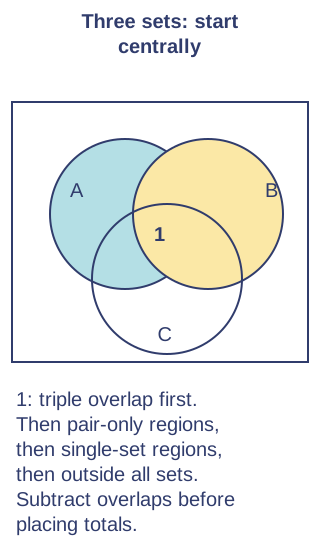
If a question uses three sets, work from the central triple overlap outwards and use the total to check the remaining region. Follow all given counts consistently.
Counts must be non-negative and sum to the stated total. A negative “only” region is a sign that the data were interpreted incorrectly.
Test yourself
50 questions · Sets of 10 from the selected tier. For fractions, use / when typing; for powers, use superscripts or ^. Follow each question's answer format. These quick checks support revision; practise full written solutions and proofs too.
Watch M37 · Sample spaces, sets and Venn diagrams
Revise sample spaces, sets and venn diagrams with this narrated video. Use the player controls to pause, seek, adjust the volume or mute. Turn English captions on or off using the captions menu.
 Mr Kidman's Classroom