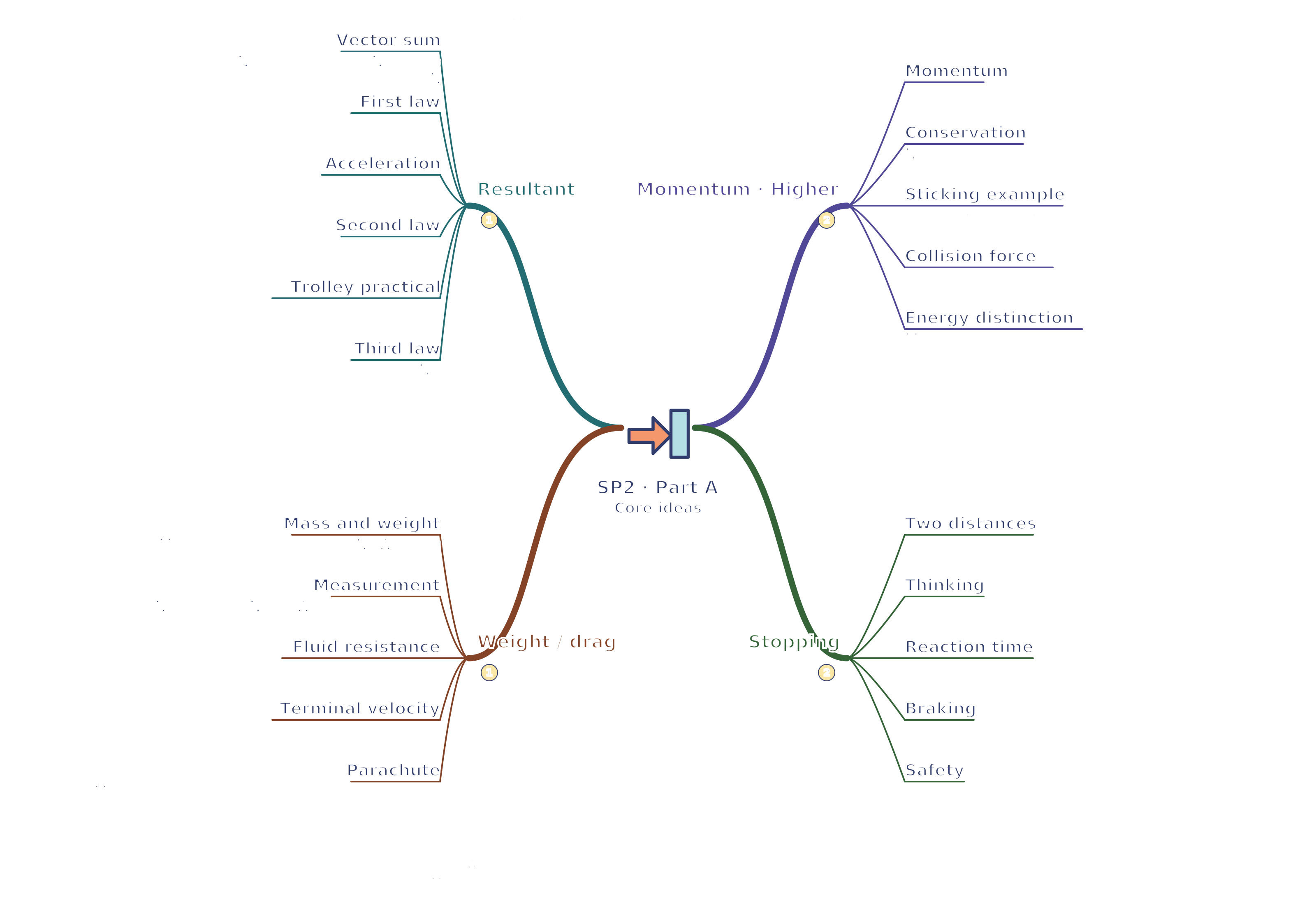
The resultant force is the overall force on one object after all its forces are combined, taking account of their directions (their vector sum). Choose positive and negative directions consistently.
A 1000 N driving force forward and 500 N drag backward give a resultant of 500 N forward.Subtract opposing forces; retain the direction of the larger force.
Balanced forces give zero resultant and no acceleration. A stationary object stays stationary; a moving object continues at constant velocity.
Newton’s first law describes this behaviour in the absence of a resultant external force. Motion does not require a continuing resultant force.
Unbalanced forces cause acceleration: a change in speed, direction or both. A moving object can slow down if the resultant opposes its velocity.
Circular motion at constant speed requires a resultant force towards the centre. This centripetal force changes the direction of velocity, so the object accelerates.
Mass, weight and resistance
Mass describes how much matter an object contains and is measured in kilograms (kg). It also measures how difficult it is to change the object’s velocity (inertia). Weight is the gravitational force on the object, measured in newtons (N).
Weight = mass × gravitational field strength, W = mg. Near Earth use g = 10 N/kg in these examples or the value given.
A 6 kg object weighs 60 N where g = 10 N/kg. Its mass stays 6 kg on the Moon, but its weight is smaller because the gravitational field is weaker.
Measure weight with a calibrated newton meter. On a weight–mass graph, the gradient is gravitational field strength.
Air or water resistance (drag) opposes an object’s movement relative to the fluid around it. Drag generally increases with speed. Streamlining reduces it.
A falling object initially accelerates because weight exceeds drag. As speed increases, drag increases and the resultant becomes smaller.
At terminal velocity, drag balances weight and acceleration is zero. The object continues falling at constant velocity; the forces have not disappeared.At terminal velocity, resultant force is zero.
Opening a parachute increases drag: the falling person slows until reaching a new, lower terminal velocity.
Newton’s second and third laws
Newton’s second law is F = ma: resultant force in N = mass in kg × acceleration in m/s². For the same mass, increasing resultant force increases acceleration.
For the same resultant force, a larger mass has a smaller acceleration. Inertial mass = F/a. It measures how strongly an object resists a change in velocity.
In the trolley core practical, vary pulling force while keeping total moving mass constant, or vary mass while keeping force constant. Use light gates or a motion sensor to calculate acceleration.
Keep track and release conditions consistent, minimise friction and repeat measurements. A hanging mass and pulley can provide a pulling force; the hanging mass belongs to the moving system.
Newton’s third law: when two objects interact, each exerts an equal and opposite force of the same type on the other.
A foot pushes a ball forward; the ball pushes the foot backward. These forces act on different objects and do not balance each other on the ball.
A book’s weight and the table’s upward normal force can balance on the book. They are not a third-law pair: the partner to Earth pulling the book is the book pulling Earth.Balanced forces on the book are not a Newton’s third-law pair.
Momentum and collision forces (Higher tier)
Momentum = mass × velocity, p = mv, in kg m/s. Momentum is a vector, so direction matters.
Total momentum is conserved in a closed system with no resultant external force: add the momenta of all objects before and after a collision, using signed velocities.
A 2 kg trolley at 3 m/s hits a stationary 1 kg trolley and they stick together. Initial momentum is 6 kg m/s; final combined mass is 3 kg, so final velocity is 2 m/s.Negligible external resultant force allows momentum conservation.
Average resultant force = change in momentum ÷ time, F = (mv − mu)/t for constant mass. Use the sign of the velocity change.
For the same change in momentum, increasing stopping time reduces average force. Crumple zones, airbags and seat belts extend stopping time and reduce injury risk.
Momentum conservation does not mean kinetic energy is always conserved. In a sticking collision, some kinetic energy is transferred to other stores.
Reaction time and stopping distance
Stopping distance = thinking distance + braking distance. Thinking distance is how far a vehicle travels before the driver starts braking.A delay before braking adds to the distance travelled.
Thinking distance = speed × reaction time, assuming speed stays constant during the reaction interval. At 20 m/s and 0.5 s, it is 10 m.
Reaction time varies between people and conditions; drugs, alcohol, tiredness and distractions can increase it. A simple ruler-drop test can investigate reaction time with repeats.
Braking distance depends on speed, mass, braking force, tyre condition, brake condition and road surface. Wet or icy roads reduce available friction.
Higher speed increases thinking distance and increases braking distance more strongly. With fixed braking force, braking distance is proportional to speed squared.
Large decelerations require large forces and can cause injury. Safety features reduce force by increasing collision time, but do not remove the momentum change.
Braking energy and estimating stopping distances
Braking transfers the vehicle’s kinetic energy into thermal energy in brakes, tyres, road and surroundings. With an approximately constant braking force, work done Fd equals initial kinetic energy ½mv².
Rearrange to braking distance d = mv²/(2F). If mass and braking force stay unchanged, braking distance is proportional to the square of initial speed: doubling speed gives four times the braking distance.The curve follows d/d₀ = (v/v₀)²; the axes use relative quantities.
Thinking distance = speed × reaction time. With the same reaction time, doubling speed doubles thinking distance. Stopping distance adds thinking and braking distances. It does not exactly follow speed squared, because only the braking part does in this model.
For a 1000 kg car travelling at 20 m/s with 5000 N braking force, kinetic energy is 200000 J and braking distance is 40 m. With reaction time 0.7 s, thinking distance is 14 m and total stopping distance is 54 m.
Use a realistic speed range to estimate emergency stopping distances and state assumptions. Wet or icy roads can reduce available braking force and lengthen braking distance; vehicle condition and driver response also matter.
In this model, increasing mass with an unchanged braking force increases braking distance. In real vehicles the available force can also change with mass, so distinguish the specified calculation model from a universal rule.
Watch SP2 · Motion and forces · Topic 2 — Motion and forces
Revise motion and forces with this narrated video. Use the player controls to pause, seek, adjust the volume or mute. Turn English captions on or off using the captions menu.
Part A · Core ideas: Resultant → Weight / drag — Balanced weight and drag produce constant terminal velocity.
Part A · Core ideas: Momentum · Higher → Stopping — Longer collision time reduces injury forces.
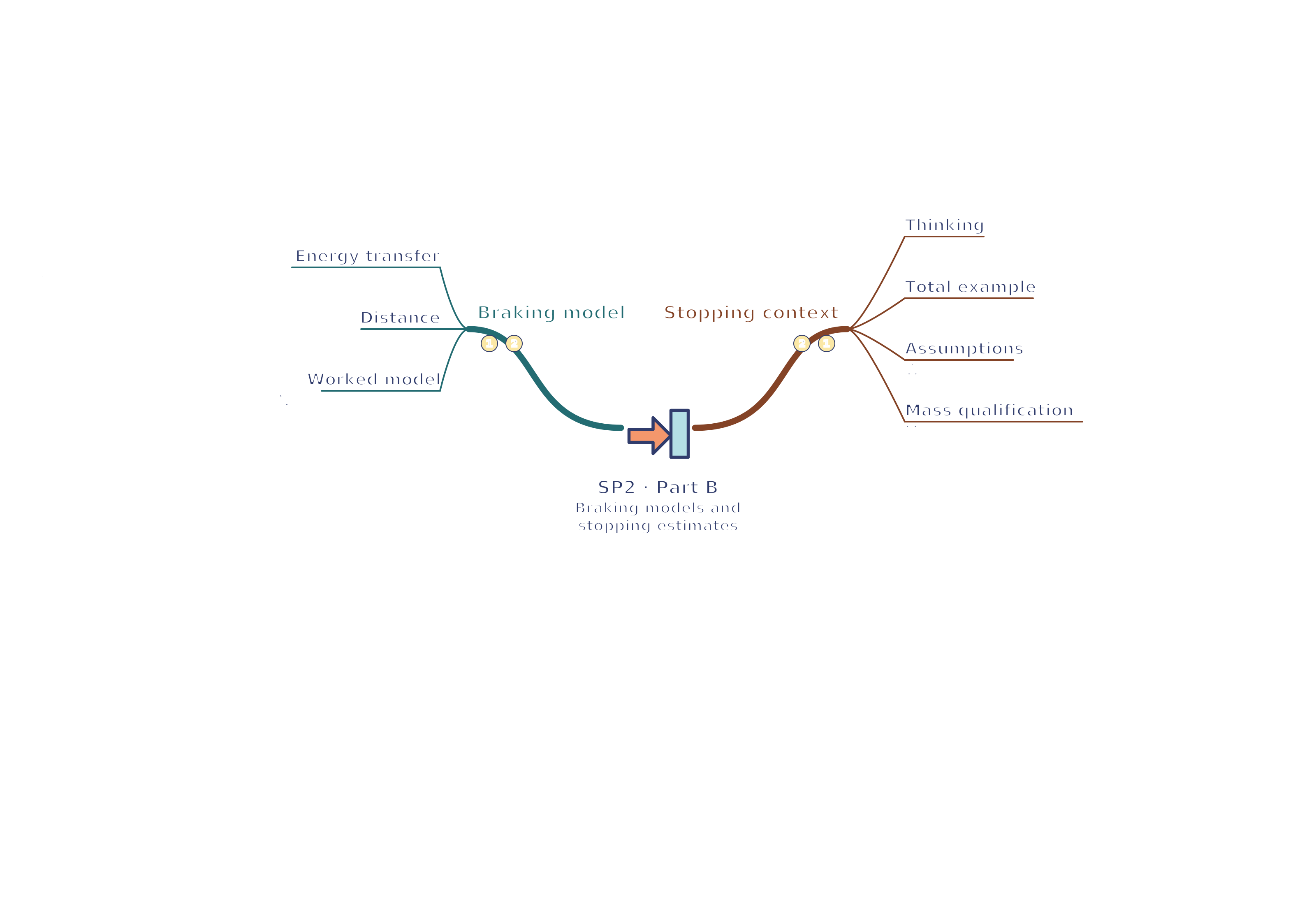
Part B · Braking models and stopping estimates: Braking model → Stopping context — Stopping distance combines two parts with different speed dependence.
Part B · Braking models and stopping estimates: Stopping context → Braking model — Road conditions and the fixed-force assumption limit model predictions.
 Mr Kidman's Classroom