Revision notes, worked examples and methods for vectors.
Notes and quizzes ready · 50 questions · Revision video ready.
Foundation shows shared notes and questions. Higher includes the shared content and labelled Higher extensions. Changing tier starts the notes and a new quiz set.
Revise the key ideas
Vector notation and arithmetic
A vector has magnitude and direction. A column vector represents 4 units right and 3 down. Its components are signed displacements, not a coordinate pair identifying one fixed point.
Equal vectors have equal components even when drawn in different positions. The negative vector reverses direction: − = .
Add component by component: + = . Geometrically, place the second arrow's tail at the first arrow's head. Head-to-tail vector addition
Subtract using the reverse vector: − = . Order matters.
Multiplying by a scalar changes length and may reverse direction. 3 = , while −2 = .
If A = (1, 2) and B = (5, −1), vector AB is B − A = . Vector BA is its negative.
A vector's magnitude follows Pythagoras: || = √(32 + 42) = 5. A translation's vector is measured in the coordinate system's units.
Higher — vector geometry and proofs
Use bold letters such as a or directed labels such as for vectors. If OA = a and OB = b, then AB = b − a.
The midpoint M of AB has OM = 12(a + b). If M divides AB in ratio 1 : 2 from A, OM = a + 13(b − a).
Vectors that are non-zero scalar multiples are parallel. To prove three points are collinear, show vectors along two joining segments are scalar multiples and share a point.
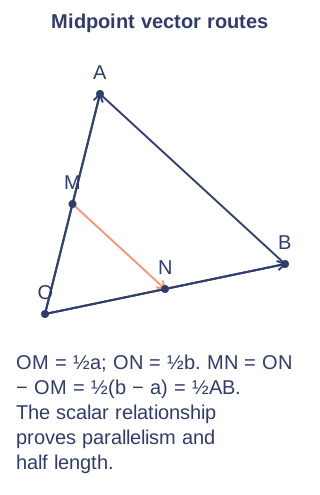
Worked example: In triangle OAB, midpoints M of OA and N of OB have OM = 12a and ON = 12b. Therefore MN = 12(b − a) = 12AB, proving MN is parallel to AB and half its length.
For a parallelogram OABC in order, if OA = a and OC = b, then OB = a + b. Diagonals can be expressed in more than one route to locate their intersection.
Direction matters in each route: AB + BC = AC, but AB + CB is different. Draw arrows and keep start/end labels consistent.
For an intersection problem, express its position along each line with parameters, equate coefficients of independent vectors and solve the resulting simultaneous equations.
Test yourself
50 questions · Sets of 10 from the selected tier. For fractions, use / when typing; for powers, use superscripts or ^. Follow each question's answer format. These quick checks support revision; practise full written solutions and proofs too.
Watch M35 · Vectors
Revise vectors with this narrated video. Use the player controls to pause, seek, adjust the volume or mute. Turn English captions on or off using the captions menu.
 Mr Kidman's Classroom