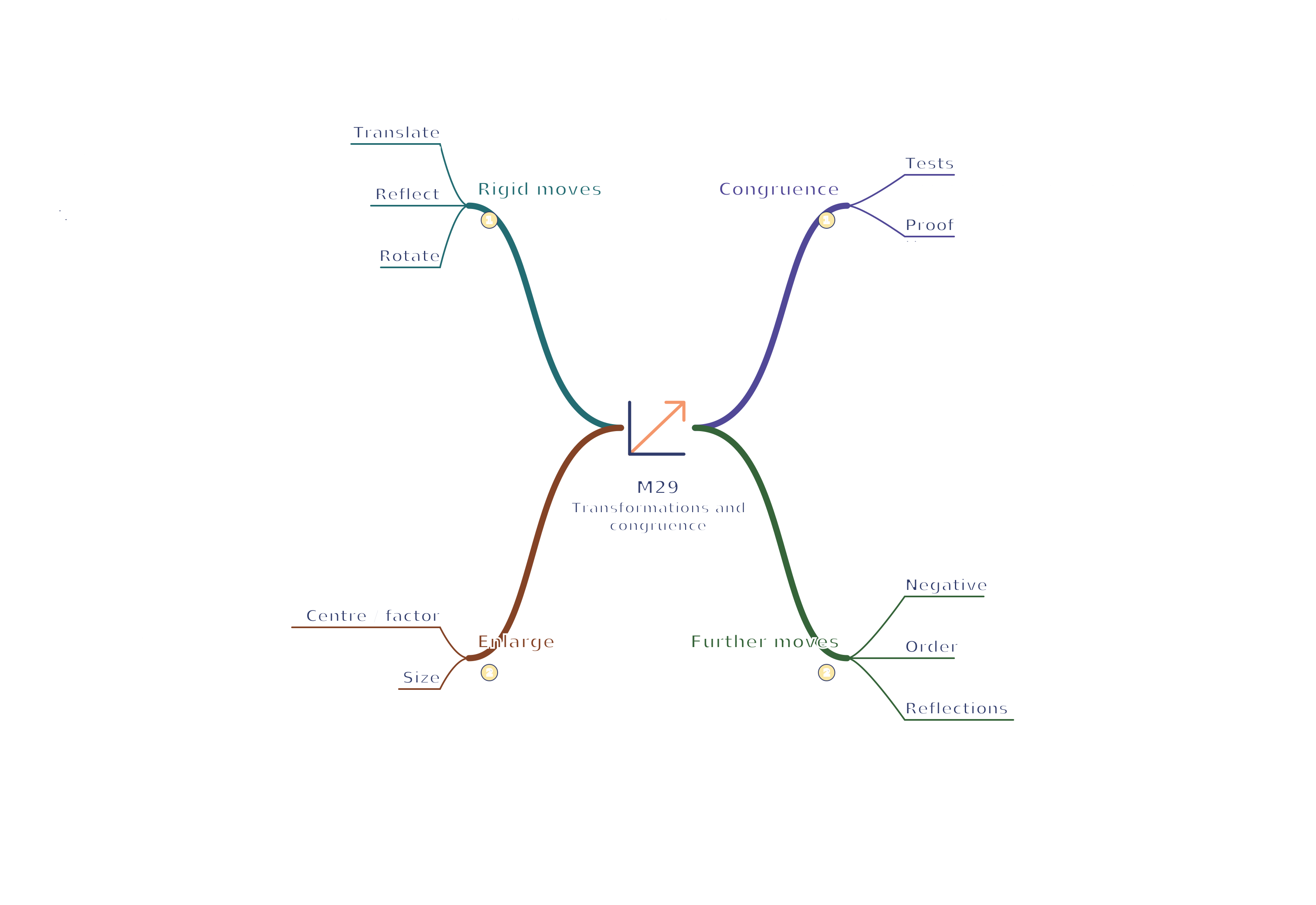
Revision notes, worked examples and methods for transformations and congruence.
Notes and quizzes ready · 52 questions · Revision video ready.
Foundation shows shared notes and questions. Higher includes the shared content and labelled Higher extensions. Changing tier starts the notes and a new quiz set.
Revise the key ideas
Describing transformations
A translation moves every point by the same vector. means 3 units right and 2 down. A complete description needs both components. A triangle translated three right and two down
A reflection needs its mirror line, for example x = 2 or y = x. Perpendicular distances from corresponding points to the mirror line are equal.
Reflecting (a, b) in the x-axis gives (a, −b); in the y-axis gives (−a, b); in y = x gives (b, a).
Worked example: A triangle with vertices (1, 1), (3, 1), (1, 3) reflects in the y-axis to (−1, 1), (−3, 1), (−1, 3). Each corresponding point is equally far from the mirror line. Reflection of a triangle in the y-axis
A rotation needs centre, angle and direction unless the angle is 180°. A 90° anticlockwise rotation about the origin sends (a, b) to (−b, a).
Worked example: Rotating (3, 1) through 90° anticlockwise about (0, 0) gives (−1, 3). Draw centre-to-point radii to check that the distance from the centre stays unchanged. A ninety-degree anticlockwise rotation
An enlargement needs a centre and a scale factor. Draw rays from the centre through each vertex and multiply each distance from the centre by the scale factor.
Worked example: Enlarging (3, 1) by scale factor 2 about (1, 1) doubles the relative vector (2, 0), giving (5, 1). Doubling the original coordinates works only for a centre at the origin.
Join each vertex and its image to the enlargement centre; corresponding points must lie on those rays. For scale factor 2, an original vertex at distance d moves to distance 2d from the centre. An enlargement with scale factor two
A positive scale factor below 1 reduces the shape. Enlargement by 12 halves every length but keeps all angles equal.
Reflections, rotations and translations preserve lengths and angles, so images are congruent. Enlargement preserves angles and proportions; it generally changes size.
Triangle congruence
Congruent triangles have corresponding sides and angles equal. Valid tests are SSS, SAS, ASA (or AAS) and RHS for right-angled triangles with equal hypotenuse and one other side.
In SAS, the equal angle must be included between the two equal sides. SSA does not generally prove congruence; AAA proves similarity only.
When using congruence in a proof, identify corresponding vertices in order, name the test, then use the corresponding equal lengths or angles.
Higher — negative factors and combinations
A negative enlargement places the image on the opposite side of the centre. Distances are multiplied by the magnitude of the factor; a factor −2 also reverses the direction of each centre-to-point vector.
Worked example: Enlarging (3, 1) by factor −2 about (1, 1) gives (−3, 1), because (1, 1) + (−2)(2, 0) = (−3, 1).
For combined transformations, apply them in the stated order; changing the order can change the result. Two translations combine by adding their vectors.
Two reflections in parallel lines produce a translation; two reflections in intersecting lines produce a rotation. Track a point and orientation to identify the resulting transformation.
Test yourself
52 questions · Sets of 10 from the selected tier. For fractions, use / when typing; for powers, use superscripts or ^. Follow each question's answer format. These quick checks support revision; practise full written solutions and proofs too.
Watch M29 · Transformations and congruence
Revise transformations and congruence with this narrated video. Use the player controls to pause, seek, adjust the volume or mute. Turn English captions on or off using the captions menu.
 Mr Kidman's Classroom