Revision notes, worked examples and methods for solids, surface area and volume.
Notes and quizzes ready · 50 questions · Revision video ready.
Foundation shows shared notes and questions. Higher includes the shared content and labelled Higher extensions. Changing tier starts the notes and a new quiz set.
Revise the key ideas
Solids, views and units
A face is a surface, an edge is where faces meet, and a vertex is a corner. A cuboid has 6 faces, 12 edges and 8 vertices. A sphere has one curved surface and no edges or vertices.
A prism has a constant cross-section along its length. A pyramid has a base and triangular faces meeting at an apex. Cylinders and cones have curved surfaces, so not every face is flat.
A plan is the view from above; an elevation is a specified side or front view. Draw the visible outline using the given dimensions, not a perspective sketch. Cuboid plan and front elevation
Volume measures space occupied and uses cubic units; surface area totals the external surfaces and uses square units. Capacity may use litres, with 1 litre = 1000 cm3.
Volumes
Volume of a cuboid = lwh. Volume of a prism = cross-sectional area × perpendicular length. A cylinder has V = πr2h.
Worked example: A triangular prism with triangle base 4 cm, perpendicular height 3 cm and prism length 8 cm has volume (12 × 4 × 3) × 8 = 48 cm3.
A pyramid has V = 13 × base area × perpendicular height. A cone has V = 13πr2h. Slant height is not the height in these volume formulae.
In a right circular cone, perpendicular height h, radius r and slant height l form a right triangle: l2 = h2 + r2. Use h for volume and l for curved surface area. Perpendicular height and slant height in a cone
A sphere has V = 43πr3. A hemisphere has half this volume: 23πr3.
Worked example: A cone with radius 3 cm and perpendicular height 8 cm has volume 13 × π × 9 × 8 = 24π cm3.
Surface areas
Surface area of a cuboid is 2lw + 2lh + 2wh. A net helps identify every face and avoid counting a hidden internal join. A net with all six cuboid faces
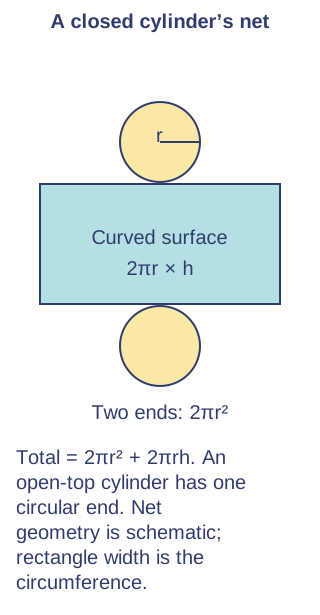
For a closed cylinder, total surface area is 2πr2 + 2πrh: two circular ends and one curved rectangular surface. An open-top cylinder has only one circular end.
A cone's curved surface area is πrl, where l is slant height. Add πr2 for its circular base when finding total surface area.
A sphere's surface area is 4πr2. A hemisphere has curved area 2πr2, or total area 3πr2 if its circular base is included.
Worked example: A closed cylinder of radius 2 cm and height 5 cm has volume 20π cm3 and total surface area 8π + 20π = 28π cm2.
For composite volumes, add non-overlapping parts or subtract a removed region. For composite surface areas, omit faces hidden where parts join. State which surfaces the question requires.
Test yourself
50 questions · Sets of 10 from the selected tier. For fractions, use / when typing; for powers, use superscripts or ^. Follow each question's answer format. These quick checks support revision; practise full written solutions and proofs too.
Watch M31 · Solids, surface area and volume
Revise solids, surface area and volume with this narrated video. Use the player controls to pause, seek, adjust the volume or mute. Turn English captions on or off using the captions menu.
 Mr Kidman's Classroom