Revision notes, worked examples and methods for quadratic equations.
Notes and quizzes ready · 50 questions · Revision video ready.
Foundation shows shared notes and questions. Higher includes the shared content and labelled Higher extensions. Changing tier starts the notes and a new quiz set.
Revise the key ideas
Solving quadratics by factorising
A quadratic equation contains a squared unknown as its highest power. Write it as ax2 + bx + c = 0, where a ≠ 0, before choosing a solution method.
If two factors multiply to zero, at least one factor must be zero. This zero-product rule applies to a product, not a sum.
Worked example: x2 + 5x + 6 = 0 becomes (x + 2)(x + 3) = 0. Therefore x = −2 or x = −3. Check each in the original equation.
Worked example: x2 = 5x gives x2 − 5x = x(x − 5) = 0, so x = 0 or x = 5. Dividing straight away by x would lose the zero solution.
For x2 = 49, x = ±7. Taking a square root without considering both signs can lose a solution.
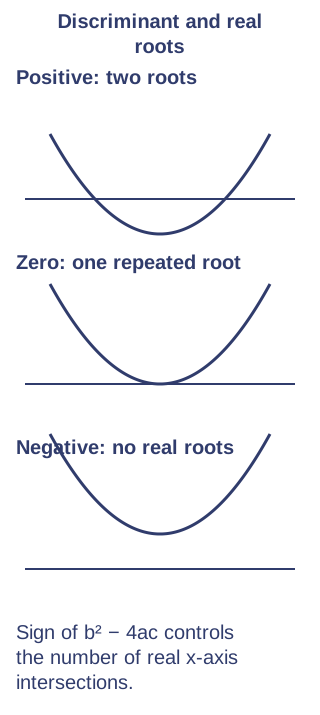
Use a graph of y = ax2 + bx + c to find approximate roots at the x-axis. A parabola may have two, one repeated, or no real roots. Roots of x squared plus five x plus six
Worked example: A rectangle has width x cm and length x + 3 cm, and area 28 cm2. x(x + 3) = 28 gives (x + 7)(x − 4) = 0. Only x = 4 cm is a valid width; a negative length is rejected with a reason.
Do not discard a negative algebraic solution unless the context rules it out. Coordinates, temperatures and some other quantities can be negative.
When using an approximate root, retain enough precision for subsequent work and round the final contextual answer appropriately.
Higher — completing the square
For x2 + bx, add and subtract (b2)2 to create a square. x2 + 6x + 5 = (x + 3)2 − 4.
Worked example: x2 + 6x + 5 = 0 gives (x + 3)2 = 4, so x + 3 = ±2 and x = −1 or −5.
Higher — the quadratic formula
For ax2 + bx + c = 0, x = −b ± √(b2 − 4ac)2a. The denominator divides the whole numerator, including the square-root term.
Worked example: 2x2 − 3x − 1 = 0 has a = 2, b = −3, c = −1. x = 3 ± √174 ≈ 1.781 or −0.281. Use brackets around negative substitutions.
The discriminant b2 − 4ac is positive for two distinct real roots, zero for a repeated root and negative for no real roots. GCSE real-number work cannot take the square root of a negative discriminant.
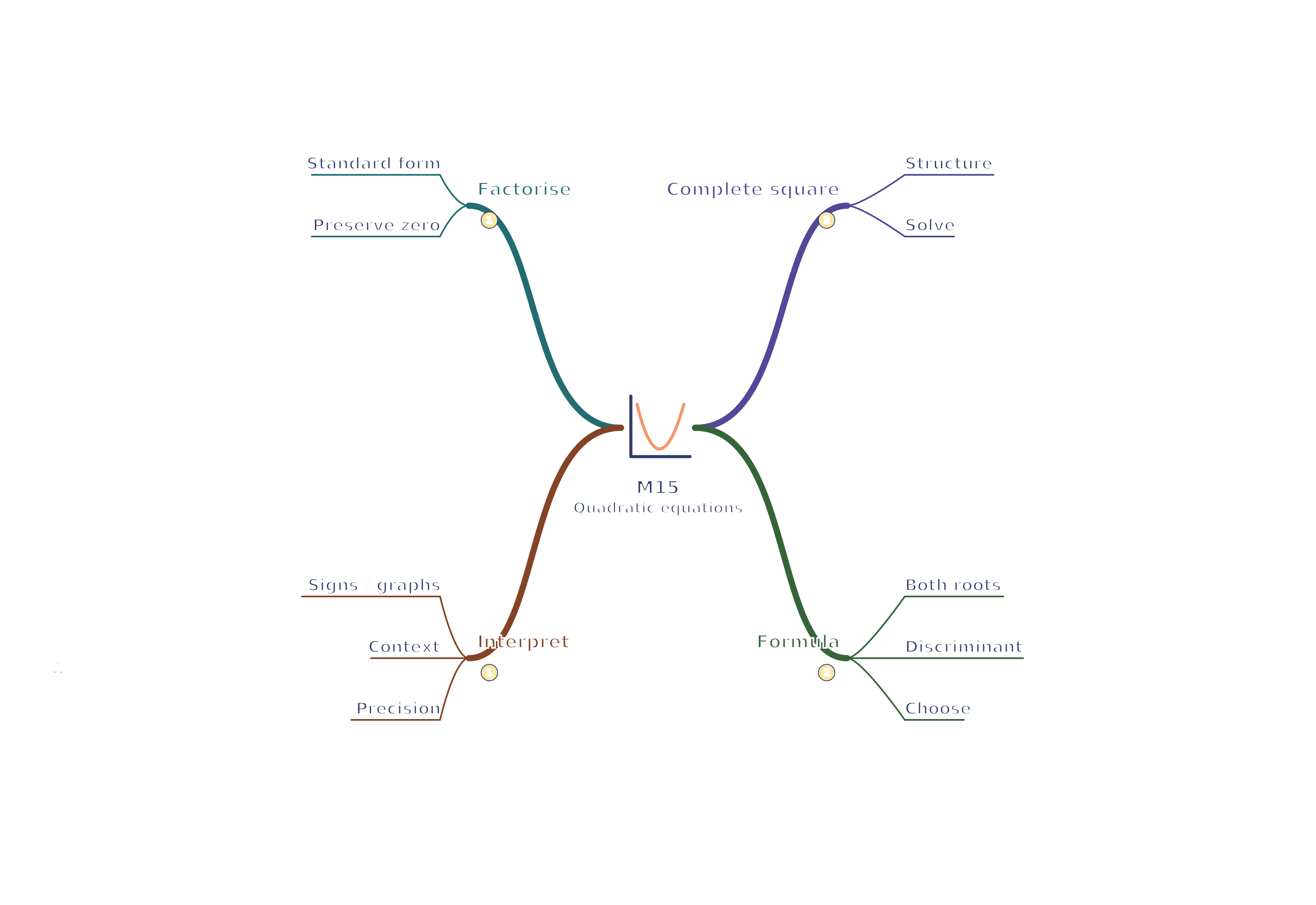
Choose an efficient method: factorise where possible, use completing the square for exact structure, or use the formula for a general quadratic. A calculator result still needs clear working when asked.
Test yourself
50 questions · Sets of 10 from the selected tier. For fractions, use / when typing; for powers, use superscripts or ^. Follow each question's answer format. These quick checks support revision; practise full written solutions and proofs too.
Watch M15 · Quadratic equations
Revise quadratic equations with this narrated video. Use the player controls to pause, seek, adjust the volume or mute. Turn English captions on or off using the captions menu.
 Mr Kidman's Classroom